BriteCore's 2026 Annual P&C Core Systems Report reveals a significant disconnect between what insurers need from their core systems and what those systems deliver, with product agility emerging as the industry's largest unmet need.
For P&C insurers, the ability to respond quickly to market opportunities has never been more important. Whether introducing new insurance products, expanding into new geographic markets, or adapting coverage to evolving risks, speed and flexibility increasingly determine competitive advantage. Yet many insurers face a fundamental obstacle: their core technology cannot keep pace with their business ambitions.
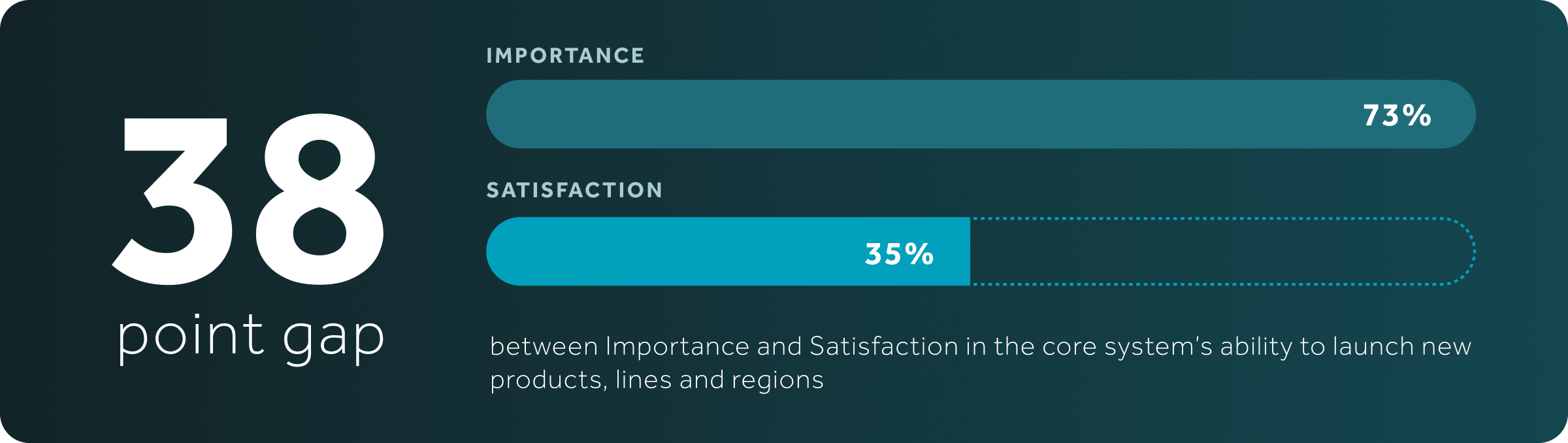
That challenge stands out in BriteCore's 2026 Annual P&C Core Systems Report, which surveyed 67 insurance professionals across regional, mid-market, and enterprise-scale carriers. The findings reveal a striking disconnect. While 73% of respondents consider the ability to easily introduce new products, lines of business, or geographic regions important, only 35% are satisfied with their current core system's ability to deliver it. That 38-percentage-point difference represents the largest importance-versus-satisfaction gap identified in the survey and raises an important question: How can insurers pursue growth and innovation when the technology supporting their business makes change so difficult?
When Core Systems Become a Barrier to Growth
Historically, insurers evaluated core systems primarily on their ability to reliably process policies, billing, and claims. Stability, security, and transactional accuracy were essential, and they remain so today. In fact, the survey found that 69% of respondents are satisfied with their core system's reliability, security, and disaster recovery capabilities. But reliability alone is no longer enough.
Today's insurers must respond to changing customer expectations, emerging risks, competitive pressures, and new distribution opportunities. That requires more than maintaining existing operations. It requires the ability to introduce and modify insurance products without lengthy development cycles, extensive customization, or costly technology projects.
The survey reinforces this shift in priorities. Faster product and technology innovation ranks as the leading modernization objective, selected by 66% of respondents. Meanwhile, 39% identify launching new products or lines of business as a growth priority, and 31% are focused on geographic expansion. These ambitions depend on an adaptable technology foundation.
When introducing a new product requires significant development resources or modifying an existing product creates downstream complexity, insurers risk missing opportunities while more agile competitors move forward. The consequences extend beyond delayed launches. Technology constraints can limit experimentation, increase operating costs, and make it harder to pursue new markets or distribution strategies.
The Growing Importance of Configuration Over Customization
Closing the product agility gap requires insurers to reconsider how their core systems accommodate change. Traditional approaches often rely on extensive customization to support unique products, underwriting rules, rating structures, and business processes. While customization can address immediate requirements, it can also introduce complexity that makes subsequent changes more difficult.
Modern core platforms offer a different approach. Through flexible configuration capabilities, insurers can adjust products, rates, rules, forms, and workflows without repeatedly undertaking major software development projects. This distinction is increasingly important because insurers need flexibility that extends beyond their initial implementation.
A core system should accommodate changing business requirements continuously, enabling insurers to respond to opportunities without rebuilding the technology supporting their operations. The survey's findings suggest this capability is becoming a defining measure of modernization success.
Product Agility Depends on More Than Product Configuration
Although product agility represents the largest capability gap, it does not exist in isolation. The survey identified additional importance-versus-satisfaction gaps in unified end-to-end operations (27 points), reporting and analytics (25 points), cloud-based capabilities (23 points), and third-party integrations (20 points). Together, these findings reveal a broader challenge.
Introducing products faster requires more than configurable product definitions. Insurers also need connected workflows, accessible data, and technology architectures that support innovation across the insurance lifecycle. For example, expanding into a new market may require integrating additional data providers, adapting underwriting processes, updating distribution channels, and incorporating new reporting requirements. Without an open, connected core platform, these activities can become separate technology projects that slow execution.
The survey underscores the importance of this foundation, with 71% of respondents identifying vendor integration and API technology as an important technology priority. For insurers, the opportunity is to establish a core platform that supports continuous change rather than requiring repeated modernization efforts.
Turning Product Agility Into Competitive Advantage
The 38-point gap highlights a critical opportunity for insurers evaluating their technology strategies. Modernization should no longer be measured simply by replacing legacy infrastructure or introducing new digital capabilities. Its value increasingly depends on how effectively technology enables the business to act.
At BriteCore, this philosophy is reflected in a cloud-native core insurance platform designed to combine operational reliability with flexible product configuration, open APIs, embedded AI, unified workflows, and continuous innovation. By reducing the complexity of introducing products and adapting business processes, modern core technology can help insurers pursue growth opportunities with greater speed and confidence.
Ultimately, the survey's findings point to a fundamental shift in expectations. The most valuable core system is no longer simply the one that reliably runs an insurer's business today. It is the one that enables the business to evolve tomorrow. For insurers looking to close the gap between ambition and execution, product agility has become a business imperative.
Download BriteCore's 2026 Annual P&C Core Systems Report to explore the findings, understand where core systems are falling short, and discover the modernization priorities shaping the future of P&C insurance.