


For P&C insurers, the promise of artificial intelligence is often described in terms of what AI might make possible in the future. At BriteCore, we are focused on a more immediate question: How much faster can AI help carriers and MGAs get real work done today?
To answer it, BriteCore has been measuring the impact of AI across some of the most time-consuming activities involved in implementing, configuring, and evolving a core insurance platform. The results demonstrate significant improvements across forms and documents, lines and rating, underwriting rules, integrations, and reporting.
In many cases, work traditionally measured in weeks can now be measured in days. Work measured in days can move to hours. And some tasks that once required hours can now be completed in minutes.
The result isn't simply faster technology. It is the potential for carriers and MGAs to launch products sooner, respond to market changes more quickly, reduce implementation effort, and put valuable capabilities into the hands of the business faster.
127 Documents. One Engineer. Five Weeks.
Forms and documents are a good example of where seemingly routine work can become a major implementation bottleneck.
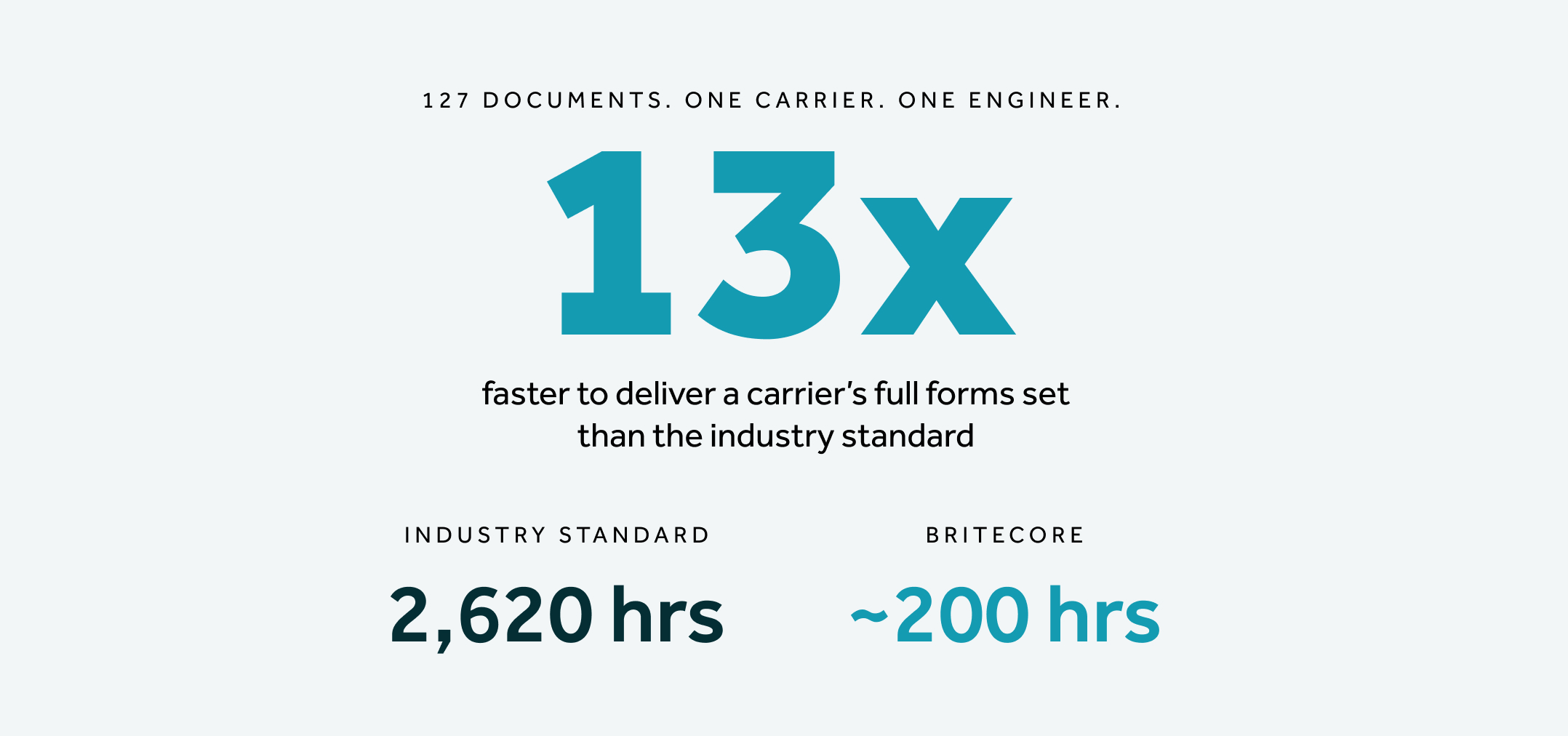
BriteCore evaluated a real carrier implementation consisting of 127 distinct documents, including dynamic declarations, quote summaries and applications as well as high-, medium-, low- and easy-complexity forms.
Using industry baseline estimates, that document mix represented approximately 2,620 hours of work, equivalent to about 15 months for one engineer. Even BriteCore's pre-AI approach reduced the estimated effort substantially, to 583 hours and approximately 3.5 months.
With BriteCore AI, the work was completed in approximately 200 hours over five weeks by one engineer, including review and feedback. Average effort fell from an industry baseline of 20.6 hours per document to approximately 1.6 hours per document.
AI also changes the feedback loop. Instead of waiting days or potentially a sprint for a correction and review cycle, BriteCore demonstrated the ability to complete three review-and-fix rounds in a single day. One engineer can own the document from beginning to end, reducing the handoffs and queues that can add additional time to traditional implementations.
For carriers, that means forms become less likely to determine the critical path of an implementation or product launch.
Building Insurance Products at a Different Pace
The impact becomes even more significant when AI is applied to lines and rating.
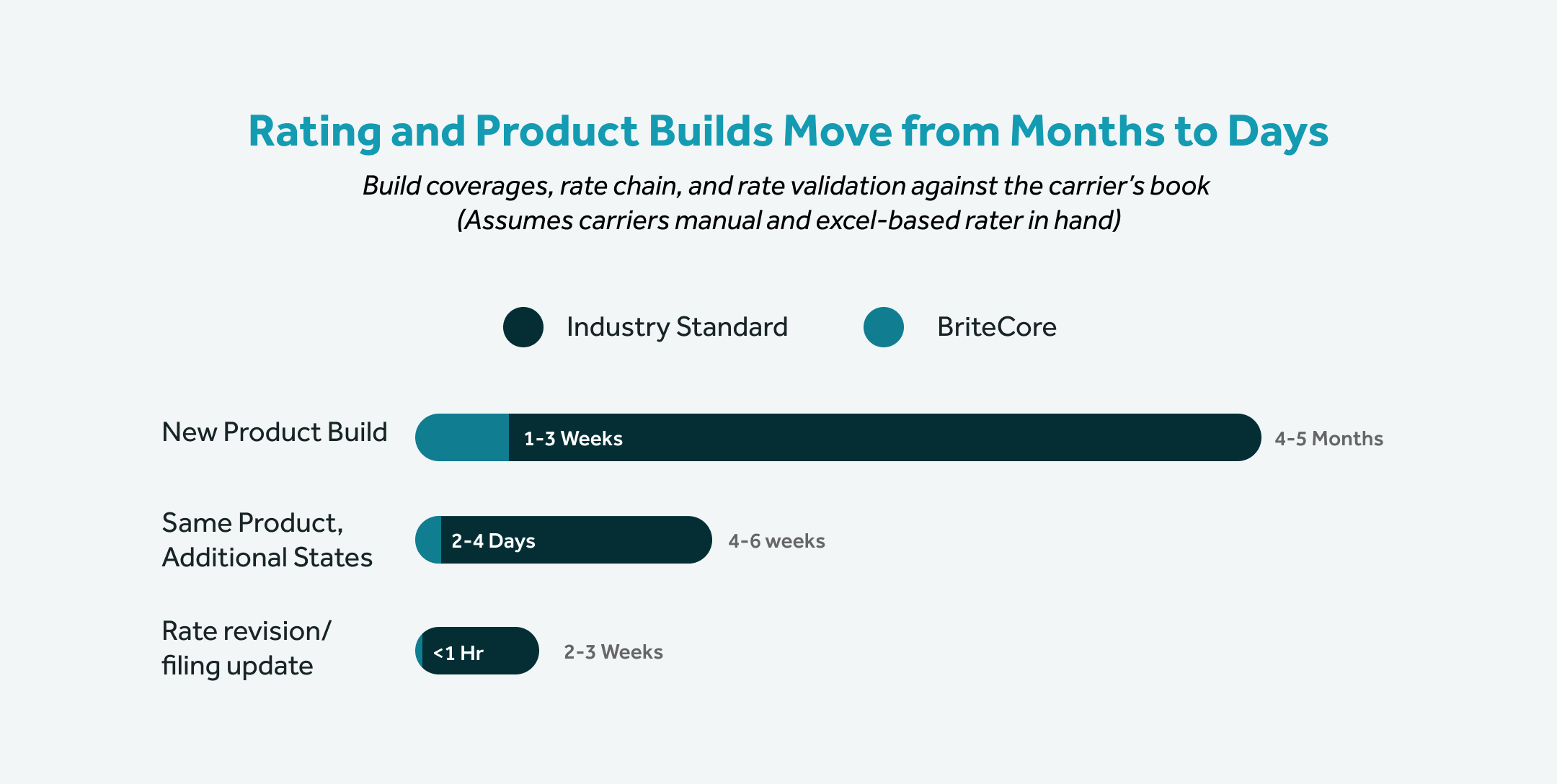
BriteCore testing indicates that building a new product such as an HO3 in one state can move from an industry baseline of four to five months to approximately one to three weeks with BriteCore AI. Extending the same product into an additional state can move from four to six weeks to approximately two to four days.
Changes to existing products can happen even faster. A new coverage or endorsement that traditionally might take one to two weeks can be completed in under an hour, as can a rate revision or filing update under the tested assumptions.
Validation is changing as well. Rather than relying on limited samples, BriteCore can replay a carrier's full in-force book against its Excel-based rater in approximately one to two days, compared with an industry baseline measured in months.
For a carrier or MGA pursuing new states, products, programs, or distribution opportunities, these improvements have strategic implications. The technology implementation can become less of a constraint on how quickly the business can pursue an opportunity.
Turning Underwriting Requirements into Rules Faster
Underwriting configuration is another area where requirements can multiply quickly.
For a 100-rule set covering areas such as eligibility, declines, referrals, straight-through processing, and subjectivities, the industry baseline is approximately one to two months. BriteCore's AI-enabled process reduces that to approximately one to two weeks.
Individual standard rules can be created in minutes, while complex multi-entity or data-driven rules can be completed in under an hour. Following a rate or coverage change, BriteCore can regression test the full rule set the same day rather than relying on sampled testing over a period of days.
An important consequence is that the bottleneck begins to move. Authoring the rules themselves can take hours; much of the remaining project time becomes carrier clarification and testing rather than the mechanics of translating requirements into platform configuration.
That creates an opportunity for carrier subject-matter experts and BriteCore teams to spend more time validating the right business logic and less time waiting for it to be built.
Accelerating the Integration Ecosystem
Modern carriers rarely operate their core platform in isolation. Data providers, payment services, document solutions, analytics platforms, and other third-party services all need to work together.
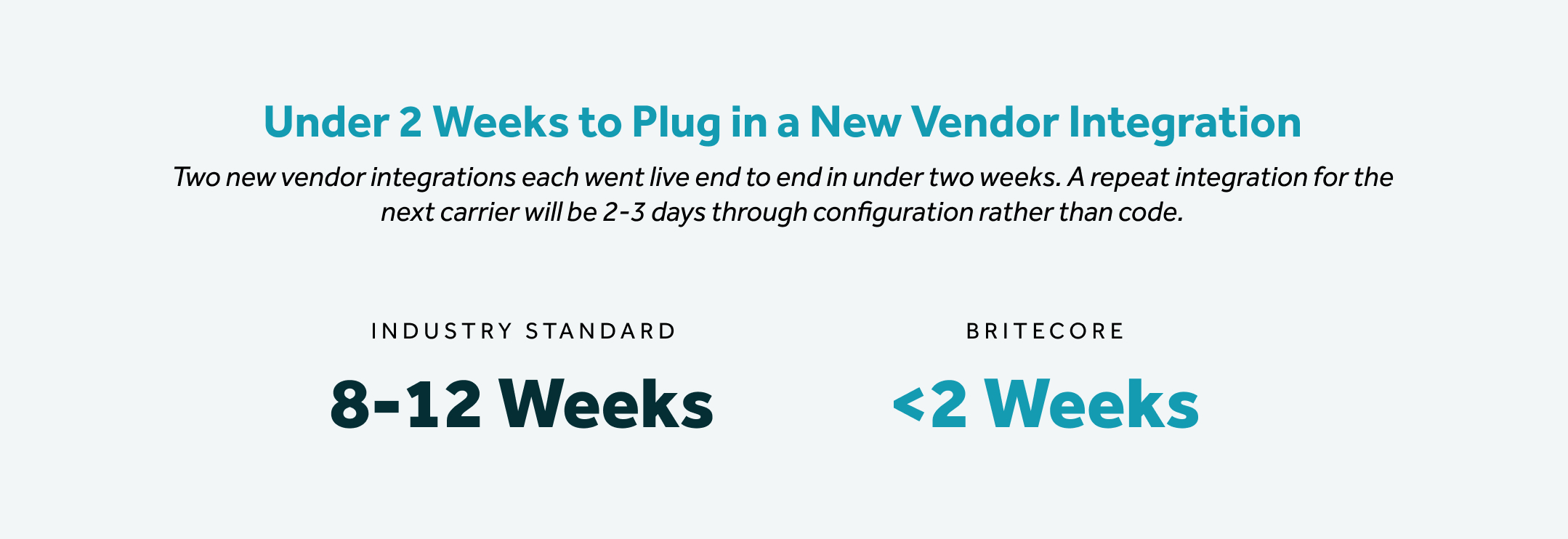
BriteCore's testing shows that a new third-party integration for a first carrier can move from an industry baseline of eight to 12 weeks to under two weeks. Once the integration exists, implementing it for another carrier can take approximately two to three days, with the work becoming configuration rather than new code.
These aren't simply theoretical estimates. BriteCore completed integrations with Verisk LightSpeed for selected data points and LenderDock NOTiFi end to end in under two weeks each.
For carriers and MGAs, faster integrations can mean faster access to the broader insurtech ecosystem and less friction when adding capabilities that support underwriting, distribution, payments, and other insurance operations.
From Reporting Backlog to Business Insight
Reporting presents a similar opportunity.
BriteCore already provides 44 stock reports across 10 categories, giving carriers a foundation that can be cloned and extended using BriteCore's SQL Editor. AI can further compress the time required to adapt that reporting environment to individual carrier needs.
A standard operational report created from a stock report can be completed in under a day, compared with an industry baseline of one to two weeks. Regulatory and statutory reports such as MCAS and stat pages can move from three to four weeks to approximately one to two days, while a net-new custom report can move from two to three weeks to two to three days.
In one measured carrier example, two BriteCore engineers completed seven regulatory reports in one week, averaging approximately 1.4 person-days per report versus an industry norm of three to four weeks.
That matters because reporting requirements don't end at implementation. They evolve alongside the carrier, making faster reporting an ongoing operational advantage.
AI That Changes the Economics of Core Platform Delivery
Taken individually, each of these improvements is meaningful. Taken together, they point toward a larger change in how carriers and MGAs can approach core platform transformation.
AI isn't simply another feature inside the core platform. BriteCore is using it to help change how quickly the platform itself can be configured, validated, integrated, and extended.
That can translate into tangible business benefits: shorter implementations and product-launch cycles, fewer manual handoffs, faster responses to rate and regulatory changes, more comprehensive testing, faster integration of third-party capabilities, and greater productivity from implementation and IT resources.
Perhaps most importantly, AI can help shift valuable human expertise toward the work where it matters most. Instead of spending weeks translating a requirement into a form, rule, rate change, report, or integration, teams can spend more time defining the right requirement, reviewing the result, and moving the business forward.
Speed Without Sacrificing Validation
Faster delivery only matters if carriers can trust what gets delivered.
That's why BriteCore is also extending AI into end-to-end validation. Today, BriteCore can replay a full in-force book against a carrier's rater and test and data-validate individual documents using live policies.
BriteCore is also building additional capabilities targeted for Q4 2026, including exhaustive rating scenario generation that extends coverage beyond scenarios represented in the existing book and automated inference and trigger-logic validation across the full policy lifecycle. These capabilities are still in development and are not included as measured performance claims in the results presented here.
The goal is not simply to use AI to build faster. It is to combine speed with increasingly comprehensive validation so carriers can move faster with confidence.
A Faster Path from Insurance Idea to Production
For carriers and MGAs, speed has become a competitive capability.
A new product that takes months to configure can mean a missed market opportunity. A rate change that takes weeks can slow the business's response to changing conditions. A lengthy integration backlog can keep valuable technology out of users' hands. And every additional month spent implementing a core platform delays the business value the transformation was intended to create.
BriteCore's results demonstrate what happens when AI is applied directly to those constraints.
127 documents in five weeks. A new one-state product in one to three weeks. Additional states in days. Rate revisions and coverage changes in under an hour. New integrations in under two weeks. Regulatory reports in days instead of weeks.
That is the opportunity BriteCore sees for AI: not AI for AI's sake, but AI applied to the practical work of building, launching, and operating insurance products.
For P&C carriers and MGAs, the ultimate measure of AI isn't how impressive the technology sounds. It's how much faster it helps turn an insurance idea into a working capability in production.